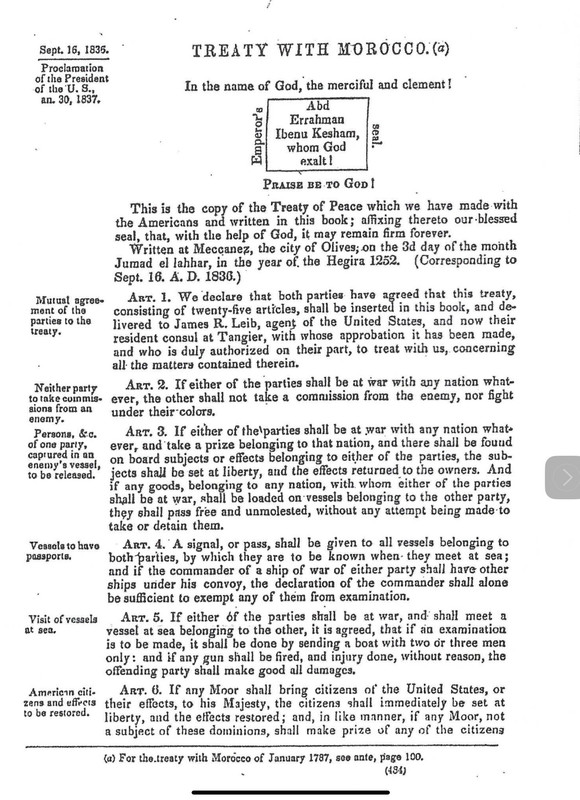
Before modern trade agreements with their thousands of pages of restrictions, the Barbary Treaties established a different model—one based on mutual respect, minimal interference, and enforceable performance. Your 1836 treaty with the Empire of Morocco is the last and most refined of these agreements.
📜 Then: Treaty-Based Trade (1836)
- Article 14: Dynamic "most favored nation" status—automatically updates to match the best terms granted to any nation.
- Article 17: No compelled purchases—merchants chose their own goods.
- Article 18: Single inspection at loading—no post-departure examination without proof.
- Article 19: No vessel detention without captain's consent.
- Article 21: Domestic courts excluded for disputes between parties; only personal acts (killing/wounding, contraband) fall outside consular venue—preserving peace by attributing accountability to individuals, not sovereigns.
- Article 24: 9 months to wind down affairs if war broke out.
- Articles 20-23: All disputes between treaty parties resolved exclusively by consuls. Trading partners' representatives may work closely with us in that process. We also handle disputes between trading partners that don't involve the U.S.
📊 Now: Modern Trade's Hidden Costs
- Non-tariff barriers: 1,200+ new trade restrictions globally since 2019
- Detention & demurrage: Average $2,500+ per container in unexpected delays
- Compliance fragmentation: 47 different customs regimes across Africa alone
- Forced localization: 34 countries now require local data/hosting
- Arbitration costs: Average ICC case costs $1.5M+ in legal fees
- Buffer days: The $149M tax we identified
The 1836 Treaty represents a forgotten alternative—a trade framework built on mutual respect, minimal interference, and enforceable commitments. Where modern agreements create complexity, the Barbary treaties created clarity. Where modern protectionism builds walls, Article 14 guaranteed dynamic "most favored nation" access. Where modern logistics suffers from unpredictable delays, Article 19 guaranteed no detention "on any pretense whatever."
We don't just study this history. We operationalize it.
"A signal, or pass, shall be given to all vessels belonging to both parties..."
In 1836 maritime law, this was not a suggestion—it was a juridical command from the Emperor. Today, vessels operating under this treaty carry that same authority: exemption from search, detention, or delay without cause. Your cargo moves under sovereign protection, not bureaucratic whim.
"If the commander of a ship of war... shall have other ships under his convoy, the declaration of the commander shall alone be sufficient to exempt any of them from examination." — Article 4
Signed September 16, 1836, and certified by the U.S. Library of Congress, this treaty remains in full force under Article 25—making it one of the oldest active trade agreements in the world. Below, we map each article to the supply chain pain points it eliminates.
📜 Certified by the Library of Congress, 2014 — View the 1836 Treaty on the U.S. State Department's Active Treaties List🚢 No Port Detention
"No vessel shall be detained in port on any pretence whatever, nor be obliged to take on board any article without the consent of the commander."
Modern relief: Eliminates unpredictable dwell times, demurrage, and forced loading—saving millions in buffer days.
"All goods shall be weighed and examined before they are sent on board; and to avoid all detention of vessels, no examination shall afterwards be made, unless it shall first be proved that contraband goods have been sent on board."
Modern relief: Single inspection at origin; no surprise post-loading exams that delay shipments.
"If any vessel of the United States shall be forced to put into our ports by stress of weather, or otherwise, she shall not be compelled to land her cargo, but shall remain in tranquillity until the commander shall think proper to proceed."
Modern relief: Safe harbor without forced discharge or additional port fees.
🛍️ Uncompelled Commerce
"Merchants shall not be compelled to buy or sell any kind of goods but such as they shall think proper."
Modern relief: No forced localization, no mandatory procurement—full freedom of contract.
"The commerce with the United States shall be on the same footing as is the commerce with Spain, or as that with the most favored nation for the time being."
Modern relief: Dynamic most-favored-nation status—automatically updates to match the best terms granted to any nation. You never need to renegotiate.
"Merchants of both countries shall employ only such interpreters... as they shall think proper... and all persons employed... shall be paid at their customary rates, not more and not less."
Modern relief: Choose your own agents; no forced labor; fair, predictable wage costs.
⚖️ Consular Jurisdiction
"If any of the citizens of the United States... shall have any dispute with each other, the consul shall decide between the parties; and whenever the consul shall require any aid... to enforce his decisions, it shall be immediately granted."
Modern relief: All disputes between treaty parties are resolved exclusively by consuls—not foreign courts. Trading partners' representatives may work closely with us in that process. We also handle disputes between trading partners that don't involve the U.S.
"If a citizen of the United States should kill or wound a Moor... the law of the country shall take place, and equal justice shall be rendered, the consul assisting at the trial."
Modern relief: Domestic courts are excluded for disputes between parties; only personal acts (killing/wounding, contraband) fall outside consular venue—preserving peace by attributing accountability to individuals, not sovereigns.
"If an American citizen shall die in our country... the consul shall take possession of his effects... and if the heir... be present, the property shall be delivered to him without interruption."
Modern relief: Immediate protection of assets; no escheatment or local confiscation.
"The consul of the United States of America, shall reside in any seaport of our dominions that they shall think proper: and they shall be respected, and enjoy all the privileges which the consuls of any other nation enjoy."
Modern relief: This article applies exclusively to parties to the treaty. Trading partners may work closely with our consuls only at their tier level.
🌟 Indulgences & MFN
"... whatever indulgence, in trade or otherwise, shall be granted to any of the Christian Powers, the citizens of the United States shall be equally entitled to them."
Modern relief: Any trade advantage given to any other nation (e.g., tariff reductions, expedited processing) automatically applies to you. You never need to negotiate separately.
"Most favored nation" treatment—dynamic and automatic.
You automatically receive the best terms Spain or any other favored nation receives, updated in real time.
🛡️ War & Crisis Provisions
"If either of the parties shall be at war with any nation whatever, the other shall not take a commission from the enemy, nor fight under their colors."
Modern relief: Guaranteed neutrality—your ships won't be conscripted or targeted.
"If goods belonging to any nation with whom either party shall be at war shall be loaded on vessels belonging to the other party, they shall pass free and unmolested."
Modern relief: Cargo immunity even if your customer is at war with a third party.
"If any Moor shall bring citizens of the United States, or their effects, to his Majesty, the citizens shall immediately be set at liberty, and the effects restored."
Modern relief: Immediate recovery of kidnapped personnel or seized goods.
"If we shall be at war with any Christian Power... no vessel belonging to the enemy shall follow, until twenty-four hours after the departure of our vessels."
Modern relief: Head start for your vessels in conflict zones.
"In case of a war between the parties, the prisoners are not to be made slaves, but to be exchanged... one hundred Mexican dollars for each person wanting."
Modern relief: Humane treatment and guaranteed ransom terms—no indefinite detention.
"If a war shall break out between the parties, nine months shall be granted to all the subjects of both parties, to dispose of their effects and retire with their property."
Modern relief: If relations ever break down, you have 9 months to wind down operations without loss—unheard of in modern sanctions.
⏳ Eternal Duration
"This treaty shall continue in force, with the help of God, for fifty years; after the expiration of which term, the treaty shall continue to be binding on both parties, until the one shall give twelve months' notice to the other, of an intention to abandon it."
Modern relief: No expiration, no renegotiation. Since 1836, neither party has given notice. It remains active—providing stability that no modern trade agreement can match.
⚓ Additional Maritime Protections
"A signal, or pass, shall be given to all vessels belonging to both parties... and if the commander of a ship of war of either party shall have other ships under his convoy, the declaration of the commander shall alone be sufficient to exempt any of them from examination."
Modern relief: Convoy protection—entire fleets move without individual inspection.
"If an examination is to be made, it shall be done by sending a boat with two or three men only: and if any gun shall be fired, and injury done, without reason, the offending party shall make good all damages."
Modern relief: Minimal-force inspections with full liability for wrongful damage.
"If any vessel of either party, shall put into a port of the other, and have occasion for provisions or other supplies, they shall be furnished without any interruption or molestation."
Modern relief: Guaranteed access to supplies in foreign ports.
"If any vessel of the United States, shall meet with a disaster at sea, and put into one of our ports to repair, she shall be at liberty to land and reload her cargo, without paying any duty whatever."
Modern relief: Duty-free temporary landing for repairs—major cost savings.
"If any vessel of either of the parties shall have an engagement with a vessel belonging to any of the Christian Powers, within gun-shot of the forts of the other, the vessel so engaged, shall be defended and protected as much as possible."
Modern relief: Active military protection if attacked near treaty partner's shores.
"If any ship of war belonging to the United States, shall put into any of our ports, she shall not be examined on any pretence whatever, even though she should have fugitive slaves on board."
Modern relief: Warship immunity—no inspection, no interference, even with sensitive cargo.
"If a ship of war of either party shall put into a port of the other, and salute, it shall be returned from the fort with an equal number of guns, not more or less."
Modern relief: Full diplomatic honors—respect and reciprocity.
The 1836 Treaty grants full consular jurisdiction to U.S. and Moroccan citizens. For trading partners, we offer structured access to this sovereign framework.
- ✅ Direct liaison with U.S. or Moroccan consul for dispute facilitation
- ✅ Treaty-based advocacy in port detentions or inspections
- ✅ Access to Article 4 "Signal" documentation for your shipments
- ✅ Everything in Tier 1
- ✅ Consular representation in local legal proceedings
- ✅ Expedited dispute resolution under Article 20 protocols
- ✅ Sovereign immunity advocacy for cargo and vessels
- ✅ Everything in Tier 2
- ✅ Designated consul liaison for your enterprise
- ✅ Full consular jurisdiction opt-in (disputes handled under treaty, not local courts)
- ✅ Sovereign-level protection for all shipments and personnel
* Tier 3 requires formal onboarding and agreement. Contact us to discuss your specific needs.
These 25 articles are not historical curiosities—they are enforceable rights you can invoke today. As Consular Economic Attaché, John Darrell-El is empowered to ensure these protections are applied to your supply chain—whether you are a U.S. citizen, Moroccan subject, or trading partner seeking consular protection.
Choose your level of protection.
🚀 Inquire About Protection TiersWhen the Architecture reduces tail delays, companies safely reduce buffer days and release trapped liquidity.
Customer retains 15% of all verified savings.
Automate release/hold evidence for origin traceability.
Sync agency sequencing to prevent silent blocks.
Control coordination exceptions during screening.
Suppress dwell variance via measurable thresholds.
Enforce compliance and cash recovery workflows.
Map & Analyze
We audit your trade lanes and surface data to pinpoint exactly where delay and cost originate.
Activate Controls
You opt into Surface Switches—CBP/ACE, TSA, terminals—to suppress variance at the source.
Verify & Scale
We deliver a baseline report proving reduction and cash impact. You keep 15% of verified savings.